
The King and Queen of Thailand’s Soft Diplomacy through 737 Presidential Piloting
Arya Yudhistira
10/28/20253 min read
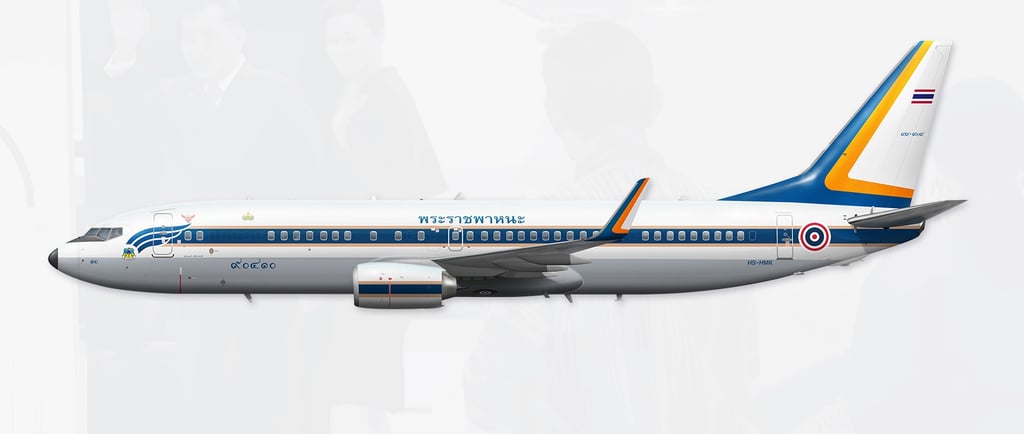
In recent years, air travel has always been the government’s favorite mode of transport. It is not limited to buying up the duration of travel, but also as a show of national power. The United States Boeing VC-25, borrowing the airframe of a 747, has always been an icon as it holds the title of the largest presidential aircraft ever built. Brunei and South Korea joined when they introduced their 747–8 BBJs. Then there are smaller presidential aircraft such as Indonesia’s 737–800BBJ1 “RI-1" or Nigerian Air Force Dassault Falcon 7X.
Presidential aircraft represent national agendas as a show of power and an implication of commitment to the occasion. Most countries have their aircrew composed of military personnel for presidential piloting, and a few leaders actually take matters into their own hands. King Willem-Alexander of the Netherlands obtained his Private Pilot’s License (PPL) and Commercial Pilot’s License (CPL) in the late 80s. He occasionally flies for the government Fokker 70, KLM Cityhopper, and ultimately the 737 BBJ. Sultan Hassanal Bolkiah of Brunei Darussalam also piloted his 747 notably from his India-ASEAN commemorative summit visit in 2012. Hence, I see presidential piloting as a move of world leaders to fly an aircraft (mostly presidential aircraft) on state duty or government-related mobilities.
Thailand seeks a bolder presidential piloting during King Maha Vajiralongkorn and Queen Suthida’s state visit to Bhutan. They successfully maneuvered the HS-HMK 737–800 into Paro, one of the most dangerous approaches in the world. There are fewer than one hundred pilots worldwide eligible to fly into Paro due to extreme mountainous approach, requiring pilots to commit to a last-minute steep bank on the short final. It has become a common humor among aviators to point out this insane airport. A few years prior, A video of a 737 from Indonesia’s Tri-MG delivering COVID-19 vaccines to the city went viral, as it shows how challenging the approach was even with a commanding pilot at the jumpseat.
Thailand’s Presidential piloting strengthens national power through soft diplomacy as it enlarges public perception regarding the personality of the state through its leader. These dynamics shape public evaluation of national leaders, especially in comparison to cases such as the general public’s evaluation of Ukraine’s Zelensky, who was once a television comedian, compared to Putin, a former KGB member. Thailand’s Presidential piloting shows the credibility of King Vajiralongkorn and Queen Suthida to the people of Paro, Bhutan, and to the entire world through media coverage. This is a method of soft public diplomacy in showing the strength of the Thailand Air Force. Moreover, King Vajiralongkorn and Queen Suthida displayed a great example of a national symbol, implying independence and advancement in national defense.
Through Thailand’s presidential piloting to Bhutan, the media dives further into King Vajiralongkorn’s military background. He studied in the Special Air Regiment in Perth, obtained courses for the Bell UH-1H rating, worth flying the Northrop F-5, SIAI-Marchetti SF 26, F16 Fighting Falcon, the Boeing 737–400, and ultimately the Boeing 737–800, alongside special military training in the United States. The Queen served as a flight attendant at first, then attended flying school in the late 2010s. The aviation background also serves as a branding, as the royal visit brought massive soft diplomacy to the people of Bhutan and ties between the two countries.
Piloting one of the most selling airliners in history marks an impactful impression. We’ve witnessed world leaders driving their own limos or riding their own bicycles. But piloting a scaled passenger aircraft is rarely expected. Leaders are perceived as vital entities that must gain maximum protocol. It is rare to see world leaders appear when they commute. Hence, most of the presidential appearances were marked by handwaves and salutes at the aircraft entrance. In most countries, the leader is the last person to board the plane. King Vajiralongkorn and Queen Suthida’s Presidential piloting gave the impression that they have sufficient capabilities to handle multiple responsibilities at once, which are doing diplomacy as well as ensuring safety and security. Both are security concerns for other nations. This marks a successful soft diplomacy to promote national strength and leadership by the King and Queen.
We saw Kim Jong Un flying a North Korean version of the Cessna 172, which was a greater example of soft diplomacy to promote DPRK’s advancements in aviation engineering. He also qualified to fly the Antonov AN-148 during a coverage. The practice of presidential piloting is a way to increase popularity and admiration amongst the public. The reel that shared his propaganda gained thousands of comments from people who found it interesting and funny. As pilots are perceived as having a job of complex responsibility, being able to “gamble” with their safety and security for tasks that are easily substituted by a military pilot implies an effective soft and public diplomacy in promoting national strength. It also improves ties between world leaders. In the last scene of the King and Queen of Thailand’s departure from Paro shows the sovereign of Bhutan stands at the apron and waves off as the mighty 737 takes off in the distance, leaving an exceptional message of strength and reliability and a successful soft diplomacy.